
Skin Hydration Systems: What the Evidence Suggests
- Skin Health & Glow Research Series
- By Purple Iris Media
- Published Jun 2026
- 11 min read
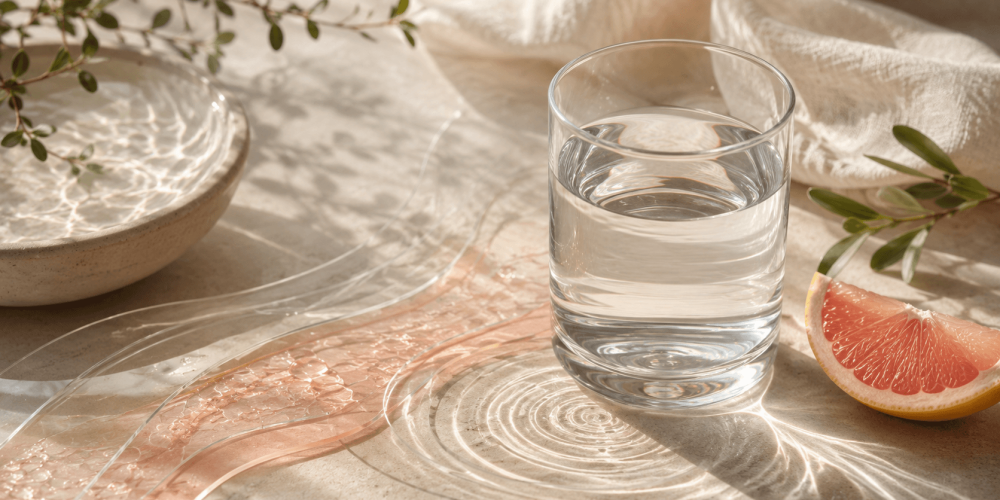
When people talk about hydrated-looking skin, the conversation often turns into a simple water story. Drink more water. Use a moisturizer. Look more refreshed. But skin hydration is more complex than that, and that complexity is actually helpful once we slow it down.
The skin does not hold water just because water is present. It holds water through a coordinated system involving the outer skin layer, barrier function, natural moisturizing factors, skin lipids, water loss, and cellular water handling. Hydration is not one switch. It is a regulated system.
Overall, the available research is strong enough to support a careful discussion of skin hydration physiology, especially around water retention, transepidermal water loss, dryness, and skin resilience. At the same time, the research does not support instant-glow claims, guaranteed visible changes, or one universal supplement rule [1][3][8].
Here, we explain what skin hydration systems are, how they overlap with barrier and skin-structure biology, what the evidence suggests, and how to think more clearly about hydration claims.
Purple Iris Media is an evidence-informed wellness education site, not a medical provider. This article explains skin hydration systems in the context of skin health education and is not medical advice. If you have persistent skin symptoms, a diagnosed skin condition, kidney concerns, medication questions, pregnancy-related questions, or supplement safety concerns, speak with a qualified healthcare professional before changing your routine.
Key Takeaways
- When we talk about skin hydration, we are describing a regulated system, not simply a matter of drinking more water.
- The evidence is meaningful, but it is not uniform. That gives us enough to have a useful conversation about hydration, while still avoiding guaranteed-result promises.
- Hydration depends closely on barrier function, stratum corneum lipids, natural moisturizing factors, dermal matrix support, and cellular water handling.
- What we find in the research is best interpreted as modest and context-dependent, not dramatic or guaranteed.
- The research does not point us toward one universal hydration dose, product format, or supplement rule.

EXAMINE
How the stratum corneum, barrier function & cellular systems regulate water in skin
UNDERSTAND

Why hydration findings are modest & context-dependent, not dramatic or guaranteed
Is Skin Hydration More Than Drinking Water?
Yes. Skin hydration is more than fluid intake because the skin also has to retain, distribute, and regulate water effectively.
The outermost layer of the skin, the stratum corneum, plays a major role in this process. Corneocytes, intercellular lipids, and natural moisturizing factors help regulate how water is held in the skin and how quickly it is lost [1][2][3].
That distinction matters because it keeps our discussion grounded. Hydration-related support may be relevant when studies measure skin hydration, dryness, or transepidermal water loss. But those findings should not be turned into a universal claim that one drink, supplement, or product can hydrate everyone’s skin in the same way.
A more useful question we can ask when evaluating a hydration claim is whether it explains how water is being retained, protected, or measured, not just whether it uses the word "hydrating".
What the Evidence Suggests So Far
Hydration is a measurable skin function
Skin hydration can be studied more directly than vague appearance claims such as “glow” or “radiance.” Researchers may measure hydration, dryness, roughness, or transepidermal water loss. Those outcomes give the discussion a clearer anchor than broad beauty language [3][8].
The evidence signal is meaningful but mixed
There are useful studies and strong biological reasons to care about hydration, but the findings are not uniform across every intervention, population, or outcome measure [3][4][7].
That means our responsible conclusion is not ”hydration products always work.” It is more careful than that: hydration is a real skin function, some interventions may influence hydration-related outcomes, and the size and relevance of those effects depend on the study context.
The expected effect pattern is modest
The most responsible reading is that hydration-related findings are likely to be modest, context-dependent, and easier to interpret when studies measure hydration, barrier function, dryness, or transepidermal water loss directly [3][8].
Nutrition-related studies may still be relevant to the broader skin-health discussion, but they are not interchangeable with direct hydration studies [4][6][7].
This is useful because it helps set realistic expectations. Hydration-related research can still matter even when the expected effect is modest. What we look for is what the study measured: hydration, dryness, barrier function, or water loss, rather than relying on broad appearance language.
How Skin Hydration Systems May Work
Stratum corneum water retention
At the surface, hydration depends heavily on the stratum corneum. This outer layer helps regulate water binding and water loss. When this system works well, our skin tends to feel smoother and more resilient. When it is disrupted, dryness, roughness, and reactivity may become more noticeable [1][2][3].
Transepidermal water loss and barrier function
Hydration cannot be separated from barrier performance. Transepidermal water loss rises when the barrier has difficulty retaining water. That is one reason fluid intake alone may not translate into hydrated-feeling skin for every person [3][8].
Dermal matrix and cellular water handling
Hydration is also influenced below the surface. Skin structure, extracellular matrix support, and aquaporin-related water and glycerol handling may all contribute to how water is distributed and retained in skin tissue [4][5]. This does not mean one pathway explains everything. It simply means hydration is broader than surface moisture alone.
The practical takeaway is simple: hydration claims are stronger when they explain a specific pathway. A claim about barrier support is not the same as a claim about water intake, and neither is the same as a broad promise of “glow.”
How This Evidence Is Interpreted
Why hydration deserves its own article
Hydration deserves its own article because it is one of the clearest ways internal skin physiology connects to what we may notice; dryness, roughness, comfort, smoothness, and resilience. That does not make hydration a promise. It makes hydration a useful system to understand.
Why there is no universal hydration dose
Hydration-related research includes different intervention types, populations, timelines, and outcome measures. Some studies examine nutrition-related skin physiology or skin-structure measures, while others focus more directly on moisturization, barrier function, or transepidermal water loss [3][4][6][7][8].
Because those study contexts are not interchangeable, the research does not support one universal hydration dose, product format, or supplement rule.
That limitation is useful. It helps us avoid assuming that every ‘hydration support’ claim is talking about the same thing. A study about barrier function, a study about antioxidant skin-structure measures, and a product claim about “glow” may all sound related, but they are not automatically measuring the same outcome.
When evaluating a hydration claim, the more useful question is what outcome was actually measured, hydration, dryness, barrier function, or water loss, rather than whether the claim uses broad appearance language.
Why limitations refine the conclusion
The limitations are meaningful but not dismissive. Study designs vary. Populations differ in baseline dryness, age, skin type, and environmental burden. Some endpoints measure hydration directly, while others blend hydration with broader texture or appearance outcomes.
Those factors keep the claim boundaries clear. They do not erase the value of the topic. They help us understand what the evidence can responsibly support and what would be an overstatement.
Understanding What the Evidence Actually Covers
What to Keep in Perspective
- The studies reviewed do not point to one verified effective dose for skin hydration overall. Hydration-related interventions are too different from one another to collapse into a single number.
- This section is descriptive. It explains how hydration has been handled in research so we can understand the evidence context. It does not tell any individual what to take, how much to take, or which product format to choose.
- This helps us read hydration claims more carefully. If a study measured transepidermal water loss, that is different from measuring perceived glow. If a study involved a specific ingredient or format, its results should not automatically be applied to every hydration product.
How Skin Hydration Was Studied
Hydration-related studies usually look at measurable skin physiology rather than a single cosmetic promise. The study context matters because hydration can involve different mechanisms and different intervention types.
OUTCOMES FOCUS
Skin hydration, dryness, transepidermal water loss, roughness, and related skin-quality measures.
INTERVENTION CONTEXT
Intervention-specific: moisturization, barrier support, nutrition-related measures, antioxidant studies, or other skin-physiology approaches.
POPULATION CONTEXT
More interpretable in adults with dryness, aging-related surface dehydration, environmental burden, or barrier-related stress.
The studies reviewed do not point to one verified effective dose for skin hydration overall. Hydration-related interventions are too different from one another to collapse into a single number.
This section is descriptive. It explains how hydration has been handled in research so we can understand the evidence context. It does not tell any individual what to take, how much to take, or which product format to choose.
This helps us read hydration claims more carefully. If a study measured transepidermal water loss, that is different from measuring perceived glow. If a study involved a specific ingredient or format, its results should not automatically be applied to every hydration product.
Things Worth Keeping in Mind
Hydration is about retention and regulation.
Water intake can matter, but our skin also needs barrier and matrix systems that help hold water where it is useful.
Baseline dryness matters.
Those of us with dryness-prone, aging-related, or barrier-burdened skin may be easier to interpret in the evidence than low-burden groups.
The topic overlaps with other skin systems.
Hydration connects strongly to barrier integrity and skin-structure support, so we need to keep those boundaries clear.
No universal benchmark is a safety feature, not a weakness.
Withholding a universal dose avoids turning a broad skin-function topic into unsupported supplement advice.
The Bottom Line
Skin hydration is not just about adding water. It is about how well the skin holds, regulates, and protects water through barrier function, natural moisturizing factors, lipids, and cellular water handling.
That makes it easier for us to evaluate hydration claims. When we encounter a product, ingredient, or wellness claim about "hydrated skin," what we want to look for is what it is actually addressing: water retention, barrier support, dryness, transepidermal water loss, or a broader appearance promise.
The responsible takeaway is optimistic but bounded: hydration matters, the system is understandable, and we do not need to treat every "glow" claim as equally meaningful.
Part of the Skin Health & Glow Research Series
We created this series to look at how internal systems may influence visible skin condition over time, and this piece on skin hydration is one part of that bigger picture. Barrier function, collagen support, oxidative stress, inflammation, and micronutrients may also shape how skin looks and feels. Our goal is not to reduce skin health to one pathway, but to help us understand how the pieces fit together.
The information in this article is for educational purposes only and is not medical advice. The guidance provided here is based on clinical research and common user experiences. Always consult with your doctor or a qualified healthcare professional before starting any new supplement. They can help you determine the right approach for your specific health needs and ensure it won’t interact with any existing conditions or medications.
Common Questions
Is skin hydration just about drinking more water?
No. Fluid intake can be part of overall health, but skin hydration also depends on barrier performance, water retention, natural moisturizing factors, and cellular water handling. That is why hydration is better understood as a system rather than a simple intake issue.
Why is the evidence described as meaningful but mixed?
The evidence is meaningful, but it is not uniform. Studies may use different interventions, populations, timelines, and outcome measures. That makes hydration a useful topic to understand, but not one where we can promise the same result for every person or every product.
Why was no universal dose listed?
No single dose was listed because hydration-related research does not revolve around one interchangeable intervention. A dose that applies to one ingredient, study design, or product format cannot automatically be applied to the entire topic. That is useful for us because it helps prevent “hydration support” from becoming a catch-all promise. That distinction helps us evaluate hydration claims more carefully rather than treating all hydration-support language as equivalent.
How is hydration different from barrier integrity?
They overlap closely, but they are not identical. Barrier integrity focuses on structural and defensive function, while hydration systems focus more specifically on water retention, distribution, and hydration-related physiology.
Does better hydration always mean better-looking skin?
Not automatically. Hydration is one contributor to smoother, more resilient-feeling skin, but visible appearance also depends on barrier function, collagen structure, inflammation, oxidative stress, environment, and baseline skin condition. A more grounded way to evaluate a claim is to ask whether it is talking about a measurable hydration outcome, a skin-comfort outcome, or a broader appearance promise.
References
[1] Proksch, E., Brandner, J. M., & Jensen, J. M. (2008). The skin: An indispensable barrier. Experimental Dermatology, 17(12), 1063–1072. https://doi.org/10.1111/j.1600-0625.2008.00786.x
[2] Madison, K. C. (2003). Barrier function of the skin: "La raison d'être" of the epidermis. Journal of Investigative Dermatology, 121(2), 231–241. https://doi.org/10.1046/j.1523-1747.2003.12359.x
[3] Rawlings, A. V., & Harding, C. R. (2004). Moisturization and skin barrier function. Dermatologic Therapy, 17(Suppl. 1), 43–48. https://doi.org/10.1111/j.1396-0296.2004.04s1005.x
[4] Boelsma, E., Hendriks, H. F. J., & Roza, L. (2001). Nutritional skin care: Health effects of micronutrients and fatty acids. American Journal of Clinical Nutrition, 73(5), 853–864. https://doi.org/10.1093/ajcn/73.5.853
[5] Boury-Jamot, M., Sougrat, R., Tailhardat, M., et al. (2006). Expression and function of aquaporins in human skin: Is aquaporin-3 just a glycerol transporter? Biochimica et Biophysica Acta — Biomembranes, 1758(8), 1034–1042. https://doi.org/10.1016/j.bbamem.2006.06.013
[6] Heinrich, U., Tronnier, H., Stahl, W., Béjot, M., & Maurette, J.-M. (2006). Antioxidant supplements improve parameters related to skin structure in humans. Skin Pharmacology and Physiology, 19(4), 224–231. https://doi.org/10.1159/000093118
[7] Draelos, Z. D. (2010). Nutrition and enhancing youthful-appearing skin. Clinics in Dermatology, 28(4), 400–408. https://doi.org/10.1016/j.clindermatol.2010.03.019
[8] Cork, M. J., Danby, S. G., Vasilopoulos, Y., et al. (2009). Epidermal barrier dysfunction in atopic dermatitis. Journal of Investigative Dermatology, 129(8), 1892–1908. https://doi.org/10.1038/jid.2009.133
Further Reading
Elias, P. M. (2005). Stratum corneum defensive functions: An integrated view. Journal of Investigative Dermatology, 125(2), 183–200. https://doi.org/10.1111/j.0022-202X.2005.23668.x