
How Much Ashwagandha Did Studies Use? What the Research Shows
- Stress & Mood Research Series
- By Purple Iris Media
- Published Oct 2025
- Updated Sep 2026
- 7 min read
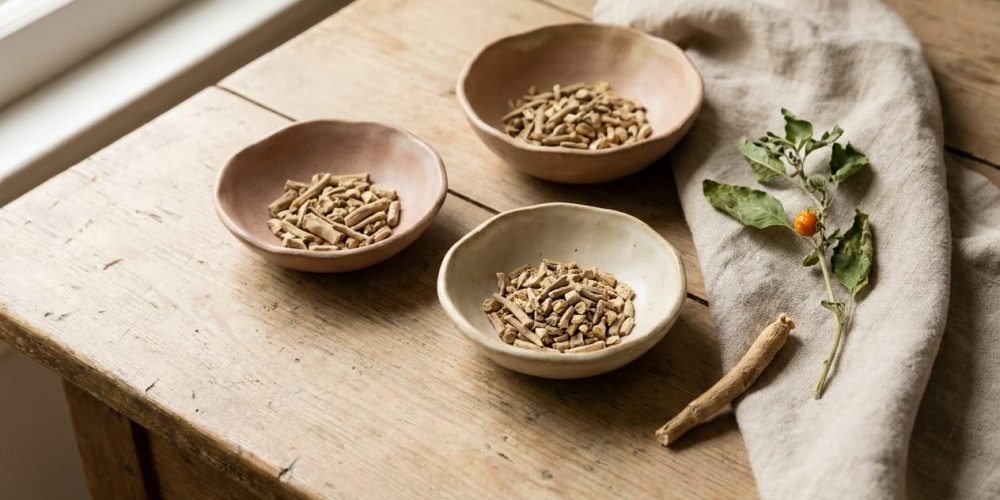
Questions about how much ashwagandha to take can sound straightforward, but the research does not point to one amount that fits every product or person. Clinical trials have tested different extracts, standardizations, daily amounts, schedules, and study lengths [1] [2] [3] [4]. Those differences make the milligram numbers difficult to compare on their own.
This guide looks at the amounts researchers studied, how the extracts differed, and what those details can—and cannot—tell us. It does not establish a personal dose. Product directions, health conditions, medications, and individual safety considerations still matter.
Purple Iris Media is an evidence-informed wellness publisher, not a medical provider. This article explains how different ashwagandha extracts and daily amounts have been studied. It does not establish an optimal dose for every person or replace professional medical care.
Ashwagandha may cause drowsiness, stomach upset, diarrhea, or vomiting, and rare cases of liver injury have been reported. Its long-term safety has not been established. It should be avoided during pregnancy and breastfeeding and may not be appropriate before surgery or for people with certain autoimmune or thyroid disorders. Ashwagandha can also interact with some medications [6].
Talk with a qualified healthcare professional before use if you have a health condition, take medication, or have questions about whether ashwagandha is appropriate for you. Follow the directions and warnings for the specific product, and do not start, stop, divide, combine, or increase servings solely to imitate a study schedule.
Key Takeaways
- Study amounts varied: The cited trials used different extracts, standardizations, daily amounts, schedules, and study lengths.
- 300–600 mg is not a universal target: This range appears in several studies of particular standardized extracts, but it does not establish the right amount for every product or person.
- The extract matters: Plant parts, extraction methods, and withanolide standardization can differ, so equal milligram amounts may not represent equivalent formulations.
- Safety and product directions still matter: Most studies were short term. Follow the directions and warnings for the specific product, and seek qualified guidance when health conditions or medications are involved.
How Ashwagandha Amounts Were Studied
The cited research did not test one standardized dosing plan. Studies used different extracts, participant groups, daily amounts, schedules, study lengths, and outcomes. The three paths below help separate what researchers tested from what the findings can reasonably tell us.
DISCOVER
Amounts and Study Design

See which daily amounts and schedules appeared in the cited trials—and how long the studies lasted.
EXAMINE
Extracts and Standardization
Compare how plant parts, extraction methods, and withanolide standardization affect what a milligram amount represents.
UNDERSTAND
Research Limits and Practical Use

Learn why study amounts are not personal dose recommendations and what product directions and safety considerations mean for practical decisions.
Amounts Used in the Cited Studies
The cited studies did not test one universal dosing plan. They used different formulations, participant groups, schedules, study lengths, and outcomes. These examples show why the amount must be read together with the rest of the study design.
240 mg per Day
One eight-week trial studied 240 mg per day of a standardized ashwagandha extract in adults who reported experiencing stress [3].
250 or 600 mg per Day
Another eight-week trial compared 250 mg and 600 mg daily amounts of a standardized root extract in healthy adults reporting stress [2].
600 mg per Day
A 60-day stress trial used 300 mg of a standardized root extract twice daily [1]. A separate 10-week insomnia trial also used 300 mg twice daily, but it examined a different participant group and outcome [5].
What this means: Several studies used daily amounts within the 240–600 mg range, but they did not establish one best starting amount or target for everyone. A repeated milligram number does not make different extracts, populations, or research questions interchangeable.
Why Extracts and Milligrams Cannot Be Compared Directly
A milligram amount tells us how much extract was used, but it does not tell the whole story. Ashwagandha preparations can differ in plant parts, extraction methods, standardization, and chemical composition. The cited research reflects that variation [4].
Plant Parts and Extraction
Some studies examined root-only extracts, while others used preparations made from both root and leaf. These formulations should not be treated as interchangeable simply because their labels show similar milligram amounts [4].
Standardization
Studies may identify the concentration of withanolides or related compounds, but the methods and measurements are not always the same. One trial studied 250 mg and 600 mg amounts of a standardized root extract [2], while another studied 240 mg of a differently standardized extract [3]. Those numbers were tested in different formulations and research settings.
Study Context
The meaning of an amount also depends on who participated, what outcome was measured, how often the extract was taken, and how long the study lasted. For example, stress and sleep trials using 600 mg per day did not answer exactly the same research question [1] [5].
What this means: A lower milligram number is not automatically weaker, and a higher number is not automatically more effective. Study amounts should not be used to convert, combine, or increase servings across products. Follow the directions and warnings for the specific formulation.
What the Research Means for Practical Use
It can be tempting to turn the study amounts into a step-by-step plan: begin at one number, wait several weeks, and increase if the expected result does not appear. The cited research does not support that shortcut.
The schedules show what researchers tested under controlled conditions. They do not establish a universal starting amount, adjustment schedule, or personal target.
The studies used specific extracts for particular participant groups and outcomes [1] [2] [3] [5]. They did not directly compare starting at 300 mg with starting at 600 mg, test 450 mg as an intermediate step, or determine that a serving should be increased after four to eight weeks.
They also did not establish that morning use is better for daytime stress, evening use is better for sleep, or dividing a daily amount produces more sustained effects. The research reviewed here does not support combining ashwagandha with magnesium, L-theanine, or another supplement as a general strategy.
Study duration is also easy to misread. An eight- or ten-week trial tells us when researchers measured outcomes; it does not tell every person how long to continue, when to change a serving amount, or whether the same result should be expected.
What this means: Use the product label as the starting point for understanding the intended serving. Do not start, divide, combine, or increase servings solely to reproduce a study schedule. When directions are unclear—or health conditions, medications, side effects, pregnancy, breastfeeding, or surgery are relevant—a qualified healthcare professional can help assess the individual situation [6].
Continue Exploring Ashwagandha
These related guides can help you compare product characteristics or look more closely at how timing and study design affect the research.
Compare Ashwagandha Products
See how five products differ in extract type, serving size, standardization, label information, and practical considerations.
Explore the Ashwagandha Supplement Guide →
Examine Timing and Study Design
Review what different extracts, daily amounts, schedules, and study lengths can—and cannot—tell us about when ashwagandha was taken.
Explore How and When to Take Ashwagandha →
The Bottom Line
Several cited trials used daily amounts between 240 and 600 mg, but those studies examined different extracts, participant groups, schedules, and outcomes. They do not establish one optimal amount, starting point, or adjustment plan for everyone.
The most useful comparison begins with more than the milligram number. Look at the plant parts used, extract type, standardization, serving size, and product directions. An amount studied for one formulation should not automatically be applied to another.
Research can help explain what has been tested, but it cannot determine whether a particular product or serving amount is appropriate for an individual. Follow the directions and warnings for the specific product, and seek qualified guidance when medications, health conditions, side effects, pregnancy, breastfeeding, or surgery are relevant.
Common Questions
Does research show that more than 600 mg works better?
No. The cited research does not establish a general rule that higher amounts produce greater benefits. Trials using different amounts also used different extracts, participant groups, schedules, and outcomes, so their results cannot be compared by milligrams alone [5].
A larger number on a study protocol does not establish that someone should exceed the serving directions for a particular product. Do not increase, combine, or divide servings solely to imitate a study. A qualified healthcare professional can help when product directions are unclear or individual health considerations are involved.
Should I take ashwagandha all at once or divide the serving?
The cited studies used different schedules. One trial used a standardized extract once daily [3], while other trials divided the studied amount into two daily servings [1] [5]. These studies did not directly compare once-daily use with divided use, so they do not establish that one schedule is better.
Follow the serving directions for the specific product. Do not divide a serving or alter its schedule solely to imitate a study, especially when the product directions do not explain how it should be used. A qualified healthcare professional can help when those directions are unclear or individual health considerations are involved.
How long does it take for ashwagandha to work?
The research does not establish one standard timeline for noticing an effect. The cited trials measured outcomes after different study periods, including 60 days, eight weeks, and ten weeks [1] [2] [3] [5]. Those periods tell us when researchers assessed participants; they do not show that everyone should expect a benefit within the same timeframe.
Responses may differ depending on the extract, product, outcome being considered, and individual circumstances. Study duration should not be treated as a reason to increase the serving amount or continue using a product despite unwanted effects.
Is it better to take ashwagandha with food or on an empty stomach?
Product directions vary, and the cited research does not establish that taking ashwagandha with food improves absorption or effectiveness. One trial instructed participants to take its particular root extract after food, but it did not compare that schedule with taking the extract on an empty stomach [1].
Ashwagandha can cause stomach upset, diarrhea, or vomiting in some people, so tolerability may also matter [6]. Follow the directions and warnings for the specific product. If unwanted symptoms occur, stop using it and consult a qualified healthcare professional rather than changing the serving amount or schedule independently.
Does everyone need to start with 300 mg of ashwagandha?
No. The cited studies assigned participants particular extracts and fixed study amounts; they did not test whether everyone should begin at 300 mg or follow a step-up plan from 300 to 600 mg [1] [2] [3] [5].
Because products differ in formulation, standardization, serving size, and directions, a study amount should not be treated as a universal starting point. Follow the directions and warnings for the specific product. If the label is unclear or health conditions or medications are involved, consult a qualified healthcare professional before use.
References
[1] Chandrasekhar, K., Kapoor, J., & Anishetty, S. (2012). A prospective, randomized double-blind, placebo-controlled study of safety and efficacy of a high-concentration full-spectrum extract of ashwagandha root in reducing stress and anxiety in adults. Indian Journal of Psychological Medicine, 34(3), 255–262.
https://doi.org/10.4103/0253-7176.106022
[2] Salve, J., Pate, S., Debnath, K., & Langade, D. (2019). Adaptogenic and anxiolytic effects of ashwagandha root extract in healthy adults: A double-blind, randomized, placebo-controlled clinical study. Cureus, 11(12), e6466.
https://doi.org/10.7759/cureus.6466
[3] Lopresti, A. L., Smith, S. J., Malvi, H., & Kodgule, R. (2019). An investigation into the stress-relieving and pharmacological actions of an ashwagandha (Withania somnifera) extract: A randomized, double-blind, placebo-controlled study. Medicine (Baltimore), 98(37), e17186.
https://doi.org/10.1097/MD.0000000000017186
[4] Speers, A. B., Cabey, K. A., Soumyanath, A., & Wright, K. M. (2021). Effects of Withania somnifera (ashwagandha) on stress and the stress-related neuropsychiatric disorders anxiety, depression, and insomnia. Current Neuropharmacology, 19(9), 1468–1495.
https://doi.org/10.2174/1570159X19666210712151556
[5] Langade, D., Kanchi, S., Salve, J., Debnath, K., & Ambegaokar, D. (2019). Efficacy and safety of ashwagandha (Withania somnifera) root extract in insomnia and anxiety: A double-blind, randomized, placebo-controlled study. Cureus, 11(9), e5797.
https://doi.org/10.7759/cureus.5797
[6] National Center for Complementary and Integrative Health. (n.d.). Ashwagandha: Usefulness and safety. National Institutes of Health.
https://www.nccih.nih.gov/health/ashwagandha