
Table of Contents
Finding Your Optimal Ashwagandha Dosage: A Research-Backed Guide
- 7 min read
- Updated October 2025
- By Purple Iris Team
You’ve decided to try ashwagandha, but now you’re staring at the bottle wondering, “How much should I actually take?” Take too little, and you might not get the benefits. Take too much, and you could risk side effects. It’s a common point of confusion.
But the good news is that decades of clinical research provide clear guidelines. Most studies showing significant benefits use doses between 300–600 mg of a standardized root extract per day [1, 2]. Your optimal dose, however, depends on the extract type, your specific goals, and even your body chemistry. To help you find it, I’ll break down exactly what the research shows so you can make the right choice for your body.
Key Takeaways
- The Proven Dose: The research consistently points to 300–600 mg daily as the sweet spot for real results [1, 2, 3].
- Start Smart: I recommend beginning with 300 mg daily for a few weeks to let your body adapt before considering an increase [4].
- The Extract Matters: Not all ashwagandha is the same. Potent extracts like KSM-66® and Sensoril® are dosed differently, so always follow the specific product's instructions [5].
- Play the Long Game: This isn’t a quick fix. Consistent daily use is what unlocks the benefits, which typically build over 4–8 weeks [2, 6].


Finding Your Effective Dose
The great thing about ashwagandha is that you don’t have to guess. My recommendations are grounded in solid clinical trials where specific doses were tested, giving us a clear road map to results.
The Core Dosing Strategy: 300–600 mg Daily
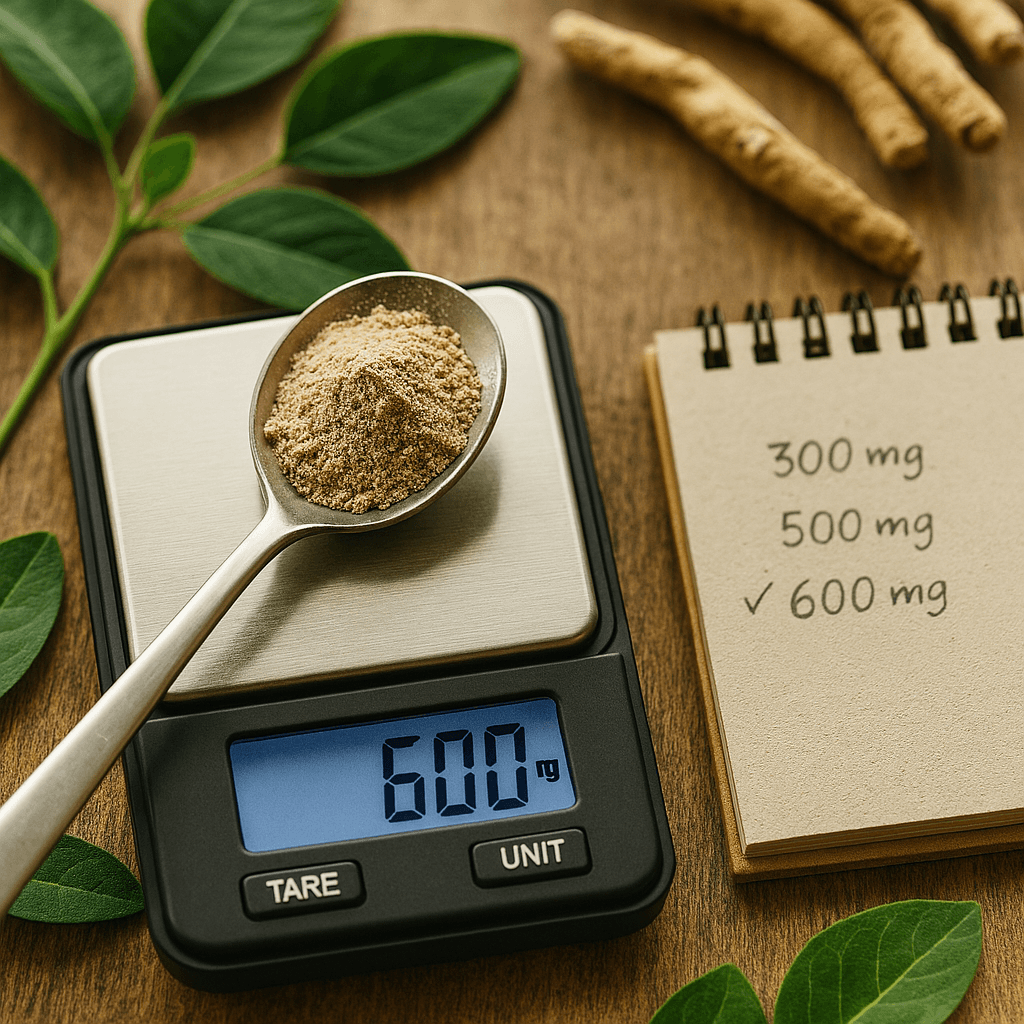
Based on the most reliable research, I guide my clients within a specific dosing window where ashwagandha delivers consistent, noticeable results for stress, sleep, and focus: 300 to 600 mg per day of a standardized root extract [1, 2, 3]. This isn’t a guess; it’s the proven sweet spot that delivers powerful benefits without unnecessary risk.
Here’s how to find the right dose for you within that range.
Your Starting Point: 300 mg Daily
This is the foundational dose for managing stress, and where I recommend everyone start. It’s the minimum effective dose proven to make a real difference.
Studies confirm that 300 mg daily can lower levels of the stress hormone cortisol by up to 28% and measurably reduce feelings of stress in under 8 weeks [1, 7]. For many, this dose is all that’s needed to build resilience and feel more centered throughout the day.
The Optimal Zone: 600 mg Daily
If you need more comprehensive support, 600 mg daily is the optimal dose. This is the level where research shows the broadest range of benefits, including deeper sleep, a significant reduction in anxiety, and sharper cognitive function [2, 8].
I consider this the target dose for unlocking ashwagandha’s full potential. You can take it all at once in the morning or, for sustained support, split it into two 300 mg doses (morning and evening)
How to Find Your Personal Dose
The goal is always to find your minimum effective dose—the smallest amount that gives you the results you want. Higher isn’t always better. Follow this simple protocol:
- Start with 300 mg daily and maintain it for at least 4 weeks.
- Assess your results. If you feel great and your goals are met, you’ve found your dose. There’s no need to increase it.
- If you want more support, increase your dose to 600 mg daily.
I rarely advise going above 600 mg. At higher doses, the benefits tend to plateau while the risk of mild side effects like drowsiness or digestive upset increases [4, 9]
A Word of Caution on Higher Doses
Clients often ask me if more is better. It’s true that some clinical trials have used doses as high as 1,200 mg per day, particularly for severe anxiety [9]. But here’s the critical takeaway from that research: the benefits don’t double just because the dose does.
You quickly reach a point of diminishing returns, where you’re taking more but not getting significantly more relief.
What the research reveals about higher doses:
For the vast majority of people, the journey ends at 600 mg. But clients often ask about doses outside that core range. Here’s what the evidence tells us, and how I interpret it for you:
- The Law of Diminishing Returns: Research into higher doses reveals a clear pattern: doubling your dose from 600 mg to 1,200 mg will not double your results. The improvements are often minor for such a large increase in dosage [9].
- Increased Side Effect Risk: The data also shows that as you climb to higher doses, the rewards often plateau while the risk of mild side effects like drowsiness or digestive upset goes up [4].
My Rule for Going Above 600 mg
I have a firm rule for any client considering a dose higher than 600 mg: this is a decision you must make with your healthcare provider.
If you’ve taken 600 mg daily for at least 8 weeks and still feel you need more support, it’s time to check in. These high-dose studies often target more severe symptoms, and a professional can help determine if this approach is right for you or if another underlying issue needs attention [9]. Don’t make this call on your own.
What About Doses Below 300 mg?
This is where listening to your body becomes critical. While more limited, research does confirm that smaller doses can offer modest benefits, especially for those who are sensitive to supplements [10].
A lower dose (around 150-250 mg daily) can be the perfect fit if you:
- Are highly sensitive to supplements.
- Have a lower body weight.
- Are simply looking for gentle, baseline support.
If a small dose gives you the focused, calm energy you’re looking for, then you’ve found your sweet spot. It’s a perfectly valid, evidence-supported approach to finding what works for you.
Fine-Tuning Your Dose: Four Factors to Consider
The 300–600 mg range is our roadmap, but finding your precise spot on that map depends on a few personal factors. Before you adjust your dose, I want you to consider these four variables.
1. The Specific Extract You Are Taking
This is the most important variable. My dosing advice is based on a standardized root extract (like KSM-66®) containing at least 5% withanolides.
You need to know that other extracts exist. Sensoril®, for example, is made from root and leaf and is standardized to a higher concentration (10% withanolides). Because it’s stronger, its effective dose is much lower—typically 125–250 mg [5].
The lesson here is simple: know your product. Taking 600 mg of a high-potency extract would be far too much. Always check the supplement facts panel and follow the dosing guidelines for the specific extract you purchased.
2. Your Primary Goal
Align your dose with your desired outcome.
- For foundational stress resilience: 300 mg daily is often the sweet spot. It builds that calm, centered feeling without needing more.
- For comprehensive support: If you’re tackling stress plus poor sleep and brain fog, aiming for 600 mg daily will deliver those broader benefits.
3. Dose Timing and Strategy
You have two effective options here. I recommend clients experiment to see what feels best:
- Single Morning Dose: Take your full dose (e.g., 300 or 600 mg) in the morning for all-day stress support and focus.
- Split Dose (Morning/Evening): Divide your total daily dose in two (e.g., 300 mg in the morning and 300 mg in the evening). This can provide more sustained effects and is my preferred method for clients who struggle with sleep.
4. Patience (The Critical Ingredient)
I tell every client this: adaptogens are not a quick fix. Ashwagandha works by helping your body gradually re-regulate its stress response system. This takes time.
The full, stable benefits often don’t appear for 4 to 8 weeks of consistent daily use [2, 6]. What feels like an ineffective dose in week two might feel like the perfect dose by week six. Before you decide to increase your dose, make sure you’ve given it enough time to work.
Your Simple Action Plan
Finding your optimal ashwagandha dose doesn’t have to be complicated. Here’s a straightforward, research-backed approach to get you started:
1. Consult Your Healthcare Provider
Before starting ashwagandha, discuss it with your doctor, especially if you have thyroid conditions, autoimmune disorders, are pregnant or breastfeeding, or take medications for blood pressure, blood sugar, or thyroid function. They can help determine if ashwagandha is appropriate for you and advise on the best starting dose.
2. Start with 300 mg Daily
Begin with a single 300 mg dose of a standardized extract (look for products containing KSM-66® or Sensoril®). Take it at the same time each day—morning if you’re focused on stress and daytime calm, evening if sleep support is your primary goal.
3. Give It Time
Commit to at least 4–6 weeks at your starting dose before making any changes. Ashwagandha’s benefits build gradually, and you need time to assess whether this dose is working for you. Keep simple notes on how you feel—changes in stress levels, sleep quality, or overall sense of calm.
4. Adjust If Needed
After 4–6 weeks, assess your progress: Feeling good results? Stay at 300 mg. There’s no need to increase if you’re getting the benefits you want.
Noticing some improvement but want more support? Increase to 450 mg or 600 mg daily, either as a single dose or split into two doses.
Not noticing much change? Consider increasing to 600 mg daily and giving it another 4 weeks. Also verify you’re using a quality product with standardized extracts.
5. Understand the Full Picture
Being informed is part of using any supplement responsibly. While generally well-tolerated, it is important to understand the potential side effects. We cover them in detail in our complete guide to Ashwagandha Side Effects.
Finally, many clients ask about combining supplements. For enhanced sleep, pairing ashwagandha with magnesium glycinate or L-theanine can be very effective. However, never combine supplements without first discussing it with your healthcare provider to ensure the combination is safe and appropriate for you.
Find the Right Ashwagandha Supplement For You
Looking for a Trusted Product?
Now that you have the right dosing strategy, the final piece of the puzzle is choosing a product that actually works. All the patience in the world won’t help if your supplement is low-quality.
To ensure your efforts pay off, I’ve reviewed and vetted the top products on the market. See which ones passed my quality standards in our guide:
After extensive research, I’ve identified the top 5 ashwagandha supplements based on purity, potency, and clinical backing. Find out which one is right for your goals.
Quick Picks: The Best Ashwagandha of 2025
The Practitioner’s Choice for Ultimate Purity: Pure Encapsulations – Trusted by functional medicine doctors and pharmacists for obsessive in-house and third-party testing that ensures zero contaminants and a potent, standardized dose you can trust implicitly.
The No-Nonsense Pick for Proven Performance: NutraBio – Delivers the clinically studied KSM-66® extract at the full 600 mg research dose with sports-nutrition-grade transparency and potency at an exceptional price.
The Smart Budget Buy for Everyday Calm: Nature’s Bounty – Combines clinically proven KSM-66® with L-Theanine for alert calm, making it a pharmacy-accessible, high-value option for taming daytime anxiety and sharpening focus.
The Holistic Choice for the Plant-Purist: Gaia – Features a full-spectrum blend of certified organic raw root and standardized extract for a gentler, traditional approach backed by radical seed-to-shelf transparency.
The Traditionalists’ Choice for Full-Spectrum Potency: Himalaya – Uniquely blends organic root powder, traditional extract, and solvent-free supercritical CO2 extraction to deliver the plant’s complete synergistic profile as Ayurvedic practice intended.
The Takeaway: Dialing in Your Dose
After all the clinical studies and dosing variables, I want to leave you with a simple truth: the numbers are just a guide. Your body’s response is the ultimate authority.
The goal isn’t to hit a specific 600 mg target; it’s to find the lowest effective dose that gives you the peace, focus, or rest you’re looking for. For many, that’s a single 300 mg capsule a day.
Remember my core principle: More is not better. Better is better.
Commit to the process. Start low, be patient, and listen to what your body is telling you. Consistency with a modest dose will always outperform inconsistent, mega-dosing. You now have the knowledge to be a careful observer of your own system. Trust that process, and you will discover if this ancient herb is the right ally for you.
Next step: Ready to choose a supplement? A high-quality, tested product makes all the difference. See our recommendations in The 5 Best Ashwagandha Supplements of 2025.
The information in this article is for educational purposes only and is not a substitute for professional medical advice. Always consult with a qualified healthcare provider before starting any new supplement. These statements have not been evaluated by the Food and Drug Administration. This product/information is not intended to diagnose, treat, cure, or prevent any disease.”
Frequently Asked Questions
Can I take more than 600 mg of ashwagandha per day?
Some clinical studies have used doses up to 1,200–1,250 mg per day with good safety profiles [9]. However, higher doses don’t necessarily provide proportionally greater benefits and may increase the risk of mild side effects like digestive upset. If you’re considering doses above 600 mg daily, consult with a healthcare provider to determine if it’s appropriate for your situation. Most people find that 300–600 mg daily provides substantial benefits without the need for higher doses.
Should I take my ashwagandha dose all at once or split it?
Both approaches work, and the choice depends on your goals and how you respond. Many clinical studies use a single daily dose of 300–600 mg with excellent results [1, 2]. However, some people prefer splitting their dose (e.g., 300 mg in the morning and 300 mg in the evening) to maintain more consistent effects throughout the day. Try a single dose first for simplicity; if you find the effects wear off too quickly, experiment with splitting your dose.
How long does it take for ashwagandha to work at the right dose?
Ashwagandha is an adaptogen that works gradually over time. While some people notice subtle effects (like improved sleep or a sense of calm) within 1–2 weeks, most clinical studies show that the most significant benefits emerge after 4–8 weeks of consistent daily use [2, 6]. If you’re not noticing results after 2–3 weeks, don’t assume it’s not working—give it the full 4–6 weeks before deciding whether to adjust your dose.
Is it better to take ashwagandha with food or on an empty stomach?
Most clinical trials don’t specify whether ashwagandha should be taken with or without food, suggesting that both approaches can be effective. However, taking ashwagandha with a meal (especially one containing some fat) may improve absorption and reduce the likelihood of mild digestive discomfort in sensitive individuals [4]. If you experience any stomach upset, try taking your dose with food.
Can I start at 600 mg, or should I always begin at 300 mg?
While 600 mg daily is within the safe and effective range studied in clinical trials [2, 8], starting at 300 mg and increasing gradually is generally recommended. This approach allows you to assess how your body responds, minimizes the risk of side effects, and helps you find the minimum effective dose for your needs. Some people get excellent results at 300 mg and never need to increase, saving money and reducing unnecessary supplement intake.
References:
[1] Chandrasekhar, K., Kapoor, J., & Anishetty, S. (2012). A prospective, randomized double-blind, placebo-controlled study of safety and efficacy of a high-concentration full-spectrum extract of ashwagandha root in reducing stress and anxiety in adults. Indian Journal of Psychological Medicine, 34(3), 255–262.
https://doi.org/10.4103/0253-7176.106022
[2] Salve, J., Pate, S., Debnath, K., & Langade, D. (2019). Adaptogenic and anxiolytic effects of ashwagandha root extract in healthy adults: A double-blind, randomized, placebo-controlled clinical study. Cureus, 11(12), e6466.
https://doi.org/10.7759/cureus.6466
[3] Lopresti, A. L., Smith, S. J., Malvi, H., & Kodgule, R. (2019). An investigation into the stress-relieving and pharmacological actions of an ashwagandha (Withania somnifera) extract: A randomized, double-blind, placebo-controlled study. Medicine (Baltimore), 98(37), e17186.
https://doi.org/10.1097/MD.0000000000017186
[4] Verma, N., Gupta, S. K., Tiwari, S., & Mishra, A. K. (2021). Safety of ashwagandha root extract: A randomized, placebo-controlled study in healthy volunteers. Complementary Therapies in Medicine, 57, 102642.
https://doi.org/10.1016/j.ctim.2020.102642
[5] Speers, A. B., Cabey, K. A., Soumyanath, A., & Wright, K. M. (2021). Effects of Withania somnifera (ashwagandha) on stress and the stress-related neuropsychiatric disorders anxiety, depression, and insomnia. Current Neuropharmacology, 19(9), 1468–1495.
https://doi.org/10.2174/1570159X19666210712151556
[6] Langade, D., Kanchi, S., Salve, J., Debnath, K., & Ambegaokar, D. (2019). Efficacy and safety of ashwagandha (Withania somnifera) root extract in insomnia and anxiety: A double-blind, randomized, placebo-controlled study. Cureus, 11(9), e5797.
https://doi.org/10.7759/cureus.5797
[7] Choudhary, D., Bhattacharyya, S., & Bose, S. (2017). Efficacy and safety of ashwagandha (Withania somnifera (L.) Dunal) root extract in improving memory and cognitive functions. Journal of Dietary Supplements, 14(6), 599–612.
https://doi.org/10.1080/19390211.2017.1284970
[8] Langade, D., Thakare, V., Kanchi, S., & Kelgane, S. (2021). Clinical evaluation of the pharmacological impact of ashwagandha root extract on sleep in healthy volunteers and insomnia patients: A double-blind, randomized, parallel-group, placebo-controlled study. Journal of Ethnopharmacology, 264, 113276.
https://doi.org/10.1016/j.jep.2020.113276
[9] Cooley, K., Szczurko, O., Perri, D., Mills, E. J., Bernhardt, B., Zhou, Q., & Seely, D. (2009). Naturopathic care for anxiety: A randomized controlled trial ISRCTN78958974. PLOS ONE, 4(8), e6628.
https://doi.org/10.1371/journal.pone.0006628
[10] Pratte, M. A., Nanavati, K. B., Young, V., & Morley, C. P. (2014). An alternative treatment for anxiety: A systematic review of human trial results reported for the Ayurvedic herb ashwagandha (Withania somnifera). Journal of Alternative and Complementary Medicine, 20(12), 901–908.
https://doi.org/10.1089/acm.2014.0177